

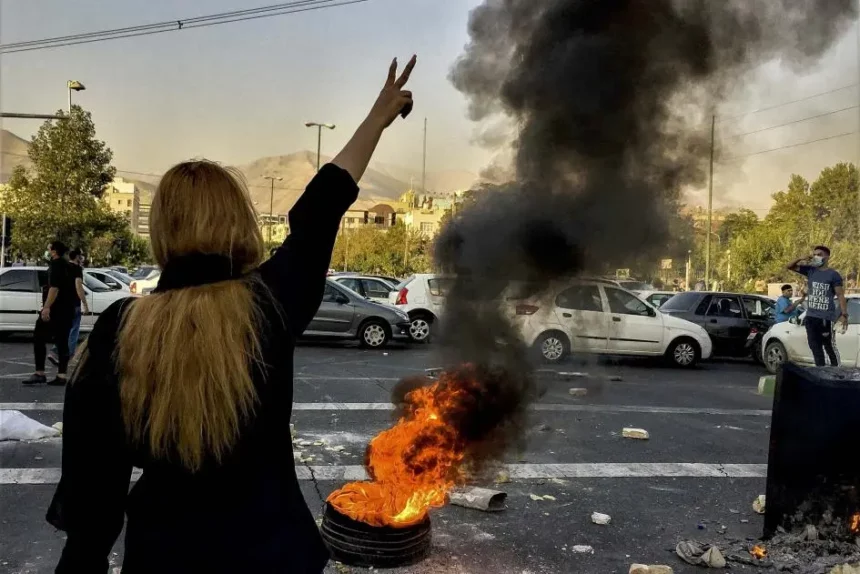
The ability of the modern state to maintain its monopoly on violence depends not only on the “legality” of that violence, but also on the existence of a minimum level of social legitimacy (Weber, 1978). What has become visible in Iran since 2022 is not the weakening of the monopoly of violence itself, but the severing of the legitimacy that sustains it. For this reason, the renewed mobilisations of recent months are better understood not as an episodic eruption of “accumulated anger,” but as a structural rupture in the state–society relationship.
- From the Ideological State to the Security Cartel: The Politics of Plunder
- Biopolitical Failure: The Revolt of the Body and the Politicisation of the Everyday
- Necropolitics and Chronopolitics: The Clash Between Death Governance and the Demand for Life
- Centre–Periphery Dialectics: From Jîna to Mahsa, Name Politics and Colonial Violence
- Post-Consent Regime and the Routine of Naked Violence
The critical threshold of this rupture was the death of Jîna Amînî, which produced a profound break in social memory. This rupture did not operate solely along the axis of “women’s rights,” but also along a dimension that rendered visible the ethnic hierarchy imposed by the centre over the periphery. Jîna’s Kurdish identity gave the event a distinct geographical and political direction as it spread from Saqqez across the country; the language of protest, articulated through the slogan “Jin, Jiyan, Azadî,” travelled from the periphery to the centre. In this way, the point of origin of the uprising exposed the regime’s long-standing application of an exception regime in peripheral regions and the hierarchical distribution of violence.
This article analyses the post-2022 period across four interrelated layers. The first concerns the regime’s transformation from an ideological state into a security cartel. The second examines the breakdown of biopolitical discipline operating through the regulation of bodies, and the politicisation of everyday life as a form of resistance (Foucault, 1978; Bayat, 2010; Butler, 1990). The third addresses the conflict between a mode of governance organised around death and fear and a social demand centred on life (Mbembe, 2003; Arendt, 1970). The fourth analyses how centre–periphery relations assume a colonial form through name politics and the spatial hierarchy of violence.
From the Ideological State to the Security Cartel: The Politics of Plunder
In its founding period, the Islamic Republic of Iran produced consent through the discourse of being the “state of the mustazafin” (the oppressed, the poor, the dispossessed), through promises of revolutionary justice, and through theological legitimacy. The transformation that became pronounced in the 2020s reflects the erosion of this discourse’s persuasive power at the societal level and the regime’s increasingly overt operation through economic networks intertwined with security apparatuses. Such a transformation turns violence from a mere instrument into a condition of the regime’s existence; as the political sphere narrows, economic rent networks and security institutions become increasingly central.
An empirical node of this transformation can be seen in the Debsh Tea corruption scandal that emerged at the end of 2023. Findings indicating that the Debsh company had received subsidised foreign currency allocations for years under the pretext of tea imports and equipment procurement, and that a significant portion of these funds was resold at higher market rates, reveal that corruption has become not an exception but a mode of governance (Iran International, 2023; Iran International, 2025). This case is not isolated; the “security cartel” character of the regime manifests itself across industrial and urban rent sectors.
For example, the Mobarakeh Steel Company (Foolad Mobarakeh) scandal, reflected in parliamentary reports in 2022, documented losses of approximately USD 3 billion that were used not only for personal enrichment but also to finance the regime’s propaganda apparatus and social media troll networks (Iran International, 2022). The point at which economic violence translates directly into physical violence and death is exemplified by the Metropol Building collapse in Abadan. Regulatory immunity granted to capital groups affiliated with the security bureaucracy led to dozens of citizens being buried under rubble; in the aftermath, the state prioritised deploying security forces to suppress public anger rather than rescue operations, thereby confirming its loss of the function of “protecting the people” (Center for Human Rights in Iran, 2022). Similarly, domestically protected automobile industries, shielded by import bans, have condemned the population to exorbitantly priced, low-safety vehicles—“moving coffins”—demonstrating how the market itself has become a form of violence (Radio Farda, 2023).
The issue here is not merely corporate malpractice. When the state’s regulatory, allocative, and judicial capacities cease to operate in the public interest, economic violence becomes a direct engine of the regime’s legitimacy crisis. The Debsh case and others thus constitute concrete indicators of a cartelised state form: as the public’s livelihood contracts, elite networks intertwined with the security bureaucracy accumulate wealth.
Within this framework, the “state” ceases to be perceived as a protective apparatus and instead becomes a predatory structure that consumes resources while generating threat rather than security. As channels of consent narrow, the regime increasingly manages social problems not through politics but through security measures and punishment. The result is the consolidation of an order that produces coercion without consent.
Biopolitical Failure: The Revolt of the Body and the Politicisation of the Everyday
Since 2022, the primary terrain of conflict in Iran has been the reorganisation of the public sphere through bodily regimes. Modern forms of power that govern populations and bodies have been particularly concentrated on women’s bodies in Iran (Foucault, 1978). Yet from 2023 onwards, what has emerged is not the absolutisation of discipline, but the erosion of its deterrent capacity. This erosion has deepened as protest has been enacted not only through slogans but through everyday life practices (Bayat, 2010).
The Ekbatan case offers a striking illustration of this transformation. A video circulated on 8 March 2023 showing young women dancing unveiled in Tehran’s Ekbatan neighbourhood was not merely an image of entertainment, but a public performance challenging the regime’s claim to normative authority over bodies. Subsequent reports of detentions and forced “confession” videos demonstrate that the state interpreted even such an everyday act as a political threat (The Times of Israel, 2023). What is most telling here is the regime’s loss of distinction between a “coup-level” threat and a dance. This loss stems from the fact that in the absence of social legitimacy, even the smallest gesture becomes legible as an anti-regime signal.
The regime’s response to this breakdown has been to intensify digital surveillance. The expansion of electronic monitoring through cameras, facial recognition, civilian informant networks, and mobile applications to enforce compulsory veiling can be read as an attempt to digitise the physical panopticon (AP, 2025; The Guardian, 2025). Yet the paradox is evident: increased surveillance has not produced automatic compliance; instead, it has normalised repression and rendered the political rupture even more visible. The bodily regime no longer generates consent; it has become a contested field, daily violated and thereby imbued with political meaning.
Necropolitics and Chronopolitics: The Clash Between Death Governance and the Demand for Life
Under conditions of deepening legitimacy crisis, power turns to governing through death when it can no longer promise life. The transformation of death, executions, street violence, and fear into techniques of governance expands the sovereign claim to decide who may live and who must die (Mbembe, 2003). Yet this expansion tends to sever social bonds rather than strengthen power, as escalating violence becomes not evidence of authority but a symptom of its erosion (Arendt, 1970).
The case of Toomaj Salehi illustrates how this necropolitical framework operates through the suppression of “voice.” Salehi’s repeated arrests, harsh sentences, and exposure to the risk of the death penalty for his protest-supporting productions and public statements reveal that the regime is waging war not only on organised politics but also on the political force of cultural expression (OHCHR, 2024; ABC News, 2024). The target here is less the punishment of an individual than the interruption of the public circulation of voice. Silencing voice is an attempt to preserve the regime’s monologue. For this very reason, networks of solidarity formed around voice generate a counter-circulation that undermines the regime’s production of fear.
This strategy of silencing, when shifted to the centre, assumes a heavier embodiment in Iranian Kurdistan through the criminalisation of ethnic identity. Kurdish rapper Saman Yasin (Seydî), sentenced to death on charges of “enmity against God” (moharebeh) for his music and public expressions during the protests—later overturned—was nevertheless subjected to severe torture and mock executions in detention (Amnesty International, 2023; Human Rights Watch, 2023). The Yasin case demonstrates that in Kurdistan the regime codes the artist not merely as a dissident voice, but as a “separatist body,” where the suppression of voice is inseparable from the threat of bodily annihilation.
Another domain targeted by the security-cartel state is language as a carrier of cultural memory. The case of Zara Mohammadi, imprisoned for extended periods for teaching Kurdish to children in Sanandaj under charges of “acting against national security,” reveals that even a civilian pedagogical activity is framed as an existential threat by the regime (Front Line Defenders, 2023). Mohammadi’s decision to defend herself in Kurdish rather than Persian during her trial can be read as a symbolic assertion of a multilingual, multi-memory counter-subjectivity against the regime’s monolingual monologue. What is being suppressed here is not merely a language, but the collective memory transmitted through it.
The colonial form of centre–periphery relations is most starkly visible in the bodies of kolbars along the border regions. Forced into this labour by structural economic exclusion, these individuals are routinely subjected to extrajudicial killings by border guards, with the line between life and death left entirely to the discretion of security forces (Hengaw, 2024; Human Rights Watch, 2021; Amnesty International, 2022). This practice demonstrates the routinisation of necropolitics in Kurdistan, where the authority to decide who lives and who dies becomes an ordinary technique of governance. Here, the state exercises its monopoly on violence not as a sovereign right but as a licence to hunt the peripheral population.
The case of Armita Geravand, who fell into a coma and subsequently died in Tehran’s metro in October 2023, constitutes another nodal point illustrating how necropolitical governance operates through space. Although the circumstances of the incident remain contested, the state’s efforts to control information flows and suppress public mourning reveal a regime panic rooted in the fear of a repetition of the 2022 Jîna Amini rupture (The Guardian, 2023). In this instance, the metro itself becomes a spatial site of bodily regulation. Public space is thus transformed from a domain of everyday circulation into a constant theatre of surveillance and potential violence.
A further dimension of this conflict concerns temporal regimes. While the regime constructs a historical time anchored in revolutionary and martyrdom narratives, younger generations inhabit a “now” structured by digital simultaneity. The crisis is therefore not only political but temporal. The regime’s attempt to slow time and bind society to mythological cycles of the past clashes with practices that accelerate time and expand life horizons.
Centre–Periphery Dialectics: From Jîna to Mahsa, Name Politics and Colonial Violence
The specific weight of the 2022 rupture lies in the fact that the spark of the uprising was ignited by the death of a Kurdish young woman. Jîna’s Kurdish identity indicates that the event cannot be reduced to a gender-based protest alone, but intersects with demands for ethnic recognition, centre–periphery relations, and the regime’s exception practices in peripheral regions. “Mahsa” is the name imposed by the state’s official Persian registry system; “Jîna” is the name given by family and community, suppressed in public space. Here, the name is not merely a label, but a political terrain of recognition and visibility. Such suppression constitutes one of the everyday workings of symbolic violence (Bourdieu, 1991). The posthumous return of the name “Jîna” represents the return of the repressed, rendering the regime’s strategy of erasure ineffective.
The spatial hierarchy of violence constitutes the core of this section. Throughout 2022 and thereafter, violence has not been distributed homogeneously across the country; it has taken more naked and lethal forms in peripheral provinces such as Kurdistan and Baluchistan. The “Bloody Friday” massacre in Zahedan on 30 September 2022, where security forces opened fire on civilians following Friday prayers, represents one of the gravest examples of how violence is escalated with relative impunity in minority regions (Amnesty International, 2022; Human Rights Watch, 2022). Such cases indicate that the periphery is effectively governed through an “enemy law” logic and that exception has been rendered permanent (Agamben, 2005).
The November 2022 crackdown in Mahabad and Javanrud further illustrates how this logic operates in Kurdish cities. Reports documenting lethal force and damage to homes during the suppression of protests in Mahabad suggest that violence was exercised not under the language of “public order,” but according to an “internal enemy zone” rationale (Human Rights Watch, 2022). Detailed reports on Javanrud document the scale and indiscriminate nature of violations, demonstrating the institutionalisation of the exception regime in the periphery (Center for Human Rights in Iran, 2023). In this configuration, the distinction between “centre” and “periphery” is not merely administrative, but maps the regime’s differential distribution of violence.
In this context, the trajectory of “Jin, Jiyan, Azadî” from Saqqez to Tehran produced an exceptional reverse flow in Iran’s political geography. Historically, the centre has spoken in the name of civilising and disciplining the periphery; in this uprising, the periphery carried the language and rhythm of opposition to the centre, translating the slogan into Persian and circulating it nationwide. This circulation did not produce a permanent integration erasing ethnic fault lines, but rather generated a fragile yet powerful moment of solidarity centred on women’s bodies and the demand for freedom. For this reason, Jîna’s Kurdish identity is not a contingent detail, but a constitutive datum that reveals the intersection of the regime’s ethnic and gendered domination.
The political significance of this reverse flow cannot be reduced to the circulation of a slogan alone. The current stance of Kurdish political actors consciously avoids confining the conflict to a narrow ethnic separation or to a militarised challenge symmetrical to the regime’s own militarisation. Instead, it seeks to expose the Iranian state’s practices in Kurdistan as a colonial exception regime while shifting the meaning of the conflict beyond debates over military balance. The shared language articulated around “Jin, Jiyan, Azadî” thus reflects an effort by the Kurdish political subject to redefine itself not merely as a suppressed identity, but as a political position that exposes the limits of the centralised nation-state model.
Post-Consent Regime and the Routine of Naked Violence
From the vantage point of January 2026, it becomes evident that the transformation of Iran’s state architecture since 2022 does not constitute a temporary crisis-management reflex, but rather points to a permanent restructuring of the regime’s institutional operation. As demonstrated above, the Islamic Republic of Iran has moved away from its hybrid structure combining ideological and republican claims, evolving instead toward a security-centred governance model reduced to its own survival. This evolution indicates the erosion of the state’s capacity to produce consent and the management of its legitimacy deficit through coercion, surveillance, and mechanisms of economic dependency.
The normalisation of emergency logic has stripped the state of its capacity to produce public good, binding it instead to an operational mode centred on the security and immunity needs of a narrow elite network. At the societal level, the resulting condition is not the restoration of political obedience, but the production of strategic silence under conditions of repression. As the state’s visibility intensifies, its relational capacity with society weakens; power is reduced from an authority capable of engaging political subjects to a technical apparatus of coercion governing biological life.
Deepening asymmetries in centre–periphery relations constitute the most fragile dimension of this governance model. While the institutionalisation of exception regimes in peripheral regions may intensify repression in the short term, it undermines the legitimacy foundations of the centralised nation-state narrative in the long term. In this sense, Iran’s current condition cannot be defined as either a stable authoritarian consolidation or an imminent regime collapse. Rather, it points to a structural deadlock in which a weakened capacity for legitimacy production is compensated for through security and exception regimes.
Rüştü DEMİRKAYA
Board Member, International Mojust Foundation
This article was originally published in Turkish on İlkeTV.com.tr and was subsequently translated into English.
References
Agamben, G. (2005). State of exception. University of Chicago Press.
Amnesty International. (2022, October 6). Iran: At least 82 Baluchi protesters and bystanders killed in bloody crackdown in Zahedan. https://www.amnesty.org/en/latest/news/2022/10/iran-at-least-82-baluchi-protesters-and-bystanders-killed-in-bloody-crackdown/ (06.01.2026)
Arendt, H. (1970). On violence. Harcourt, Brace & World.
Associated Press. (2025, March 14). UN report warns Iran is stepping up electronic surveillance of women to enforce headscarf laws. https://apnews.com/article/iran-protests-un-report-mahsa-amini-hijab-e6d33c4f45f0181b9bc4669aef196209 (06.01.2026)
Bayat, A. (2010). Life as politics: How ordinary people change the Middle East. Stanford University Press.
Bourdieu, P. (1991). Language and symbolic power. Harvard University Press.
Butler, J. (1990). Gender trouble: Feminism and the subversion of identity. Routledge.
Center for Human Rights in Iran. (2022, May 26). Iran: State Corruption and Incompetence Behind Deadly Building Collapse in Abadan https://iran-hrm.com/2022/05/28/state-corruption-metropol-building-collapse/ (06.01.2026)
Center for Human Rights in Iran. (2023). Massacre in Javanrud: State atrocities against protesters in Iran’s Kurdish regions (Report). https://iranhumanrights.org/wp-content/uploads/Massacre-in-Javanrud-Iran-Violations-Report.pdf (06.01.2026)
Foucault, M. (1978). The history of sexuality, Volume 1: An introduction. Pantheon.
Front Line Defenders. (2022, January 10). Woman human rights defender Zara Mohammadi begins serving five year prison sentence. https://www.frontlinedefenders.org/en/case/zara-mohammadi-begins-serving-five-year-prison-sentence
Human Rights Watch. (2022, November 23). Iran: UN Rights Council should create fact-finding mission. https://www.hrw.org/news/2022/11/23/iran-un-rights-council-should-create-fact-finding-mission (06.01.2026)
Human Rights Watch. (2022, December 22). Iran: “Bloody Friday” crackdown this year’s deadliest. https://www.hrw.org/news/2022/12/22/iran-bloody-friday-crackdown-years-deadliest (06.01.2026)
Hengaw Organization for Human Rights. (2025, December 30). Hengaw special report on widespread human rights violations in Iran, 2025. https://hengaw.net/en/reports-and-statistics-1/2025/12/article-7 (06.01.2026)
Iran International. (2022, August 25). Iran’s $3 Billion Embezzlement Scandal: The Tip of the Iceberg. https://www.iranintl.com/en/202312178719 (06.01.2026)
Iran International. (2023, December 13). Lawmakers demand answers in Iran’s $3.5bn tea scandal. https://www.iranintl.com/en/202312131559 (06.01.2026)
Iran International. (2025, March 3). Iranian ex-ministers sentenced in major trade corruption case. https://www.iranintl.com/en/202503030320 (06.01.2026)
Iran Human Rights Monitor. (2024). 2023 Annual Report: Iran Human Rights Monitor. https://iran-hrm.com/2024/01/01/2023-annual-report-iran-human-rights-monitor-iran-hrm/ (06.01.2026)
Mbembe, A. (2003). Necropolitics. Public Culture, 15(1), 11–40.
OHCHR. (2024, April 25). Iran: UN experts alarmed by death sentence imposed on rapper and songwriter Toomaj Salehi. https://www.ohchr.org/en/press-releases/2024/04/iran-un-experts-alarmed-death-sentence-imposed-rapper-and-songwriter-toomaj (06.01.2026)
Radio Farda. (2023, January 4). High Prices, Low Quality: Iran’s Car Market In Crisis. https://en.radiofarda.com/a/31049251.html (06.01.2026)
The Guardian. (2023, October 30). Iran arrests lawyer at funeral of girl who died after metro incident. https://www.theguardian.com/world/2023/oct/30/iran-arrests-top-rights-lawyer-at-funeral-of-teenage-girl-who-died-after-metro-incident (06.01.2026)
The Guardian. (2025, March 24). Drones, informers and apps: Iran intensifies surveillance on women to enforce hijab law. https://www.theguardian.com/global-development/2025/mar/24/iran-police-women-surveillance-hijab-drones-dress-code-law (06.01.2026)
The Times of Israel. (2023, March 14). Concern grows for Iranian women dancing unveiled in viral “Calm Down” video. https://www.timesofisrael.com/concern-grows-for-iranian-women-dancing-unveiled-in-viral-calm-down-video/ (06.01.2026)
Weber, M. (1978). Economy and society (G. Roth & C. Wittich, Eds.). University of California Press.