

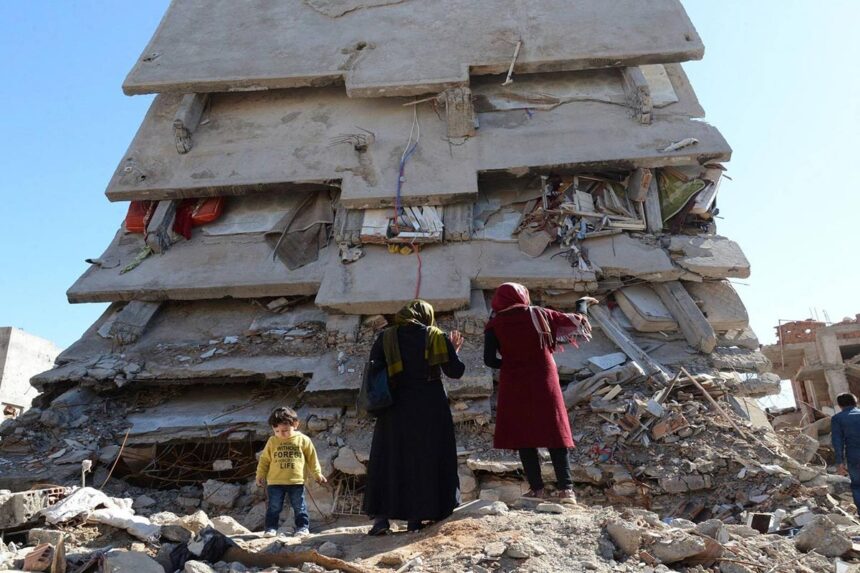
The year 2015 can be considered a critical threshold at which a clear shift in Turkey’s approach to the Kurdish political sphere became visible. During this period, prolonged security-oriented interventions implemented in Kurdish-majority provinces produced lasting effects on social and political life in the region. Assessments published by international human rights mechanisms[1] drew attention to the destructive consequences of these practices. Although this period is commonly described in Turkey as the “end of the peace process,” such a designation remains limited in its capacity to grasp the scope and nature of the transformation that took place.
This formulation signals the termination of a process, yet it does not explain why the state made this decision or what kind of institutional architecture it subsequently produced. What renders 2015 analytically significant is not the resumption of armed conflict, but the state’s move to reorganize the Kurdish political sphere in a manner that would prevent it from crossing a certain threshold. That threshold concerns not merely the production of political representation, but the capacity to combine representation with governance and thereby constitute a political form. Turkey’s post-2015 actions should therefore be read not as isolated events, but as elements of a regime design aimed at permanently closing off this threshold.
The defining feature of this regime design lies in the fact that the state does not merely suppress the Kurdish political field. Rather, it reshapes, fragments, temporally suspends, and legally places this field in abeyance—both domestically and beyond its borders. Within this framework, Rojava does not constitute a “foreign policy dossier,” but rather the principal arena in which the regime established inside Turkey is rendered consistent across borders. Consequently, Turkey’s policy toward Rojava belongs to the same logic as its approach to Kurdish politics within its own territory. The relationship between the two is not one of shared intent, but of a single institutional architecture operating across distinct spatial contexts.
The Administrative Reconfiguration of Political Representation
A central role in the institutionalization of the post-2015 Kurdish regime[2] has been played by the systematic removal of elected local governments and their replacement with state-appointed trustees. Interpreting this practice merely as the “seizure of municipalities” remains insufficient. The trustee system functioned as a technique that disrupted the continuity Kurdish politics had established at the local level. Local political space was stripped of its capacity to generate demands and articulate collective will, while local government was transformed into an administrative apparatus operating as an extension of central authority.
This mechanism produced two principal outcomes. First, it rendered the legitimacy of Kurdish political representation permanently contestable, as the capacity of electoral mandate to confer political legitimacy was made subject to administrative suspension. Second, it curtailed Kurdish actors’ ability to organize local politics through social mobilization and resource distribution. This contraction was not merely institutional but societal in nature, since municipalities in Kurdish regions function not only as service providers but as key sites through which political life circulates in everyday practice.
Academic literature has extensively documented the scope and persistence of trustee appointments, demonstrating that this practice represents not an exceptional measure but an institutionalized instrument of authoritarian governance at the local level. Studies examining the replacement of elected mayors with appointed trustees within the framework of “authoritarian neoliberalism” and the dismantling of local democracy underscore this continuity[3]. Public reports and monitoring initiatives since 2016 similarly point to the systematic expansion of trustee governance[4].
This configuration does not seek the complete elimination of Kurdish politics, but rather the permanent weakening of its political capacity through administrative intervention. Representation remains formally possible, yet its institutional continuity is never secured. This constitutes a defining threshold of the regime. The state does not entirely refuse engagement, but renders political interlocution persistently conditional upon the threat of administrative intervention.
The Judicialization of the Political Sphere
The second dimension of the post-2015 regime involves the transformation of law from a mechanism of regulation into an instrument of political sanctioning. The issue at stake here is not a series of isolated court cases, but the systematic use of legal procedures to delineate the boundaries of political participation. This logic manifests itself through prolonged pre-trial detentions of elected officials, pressure exerted on political parties and civil society organizations, and the narrowing of spaces for expression and association.
In this context, the Demirtaş cases before the European Court of Human Rights constitute more than individual proceedings; they function as indicators of how the criminalization of Kurdish politics has been juridically constructed. Court judgments and subsequent assessments demonstrate how politicized detentions and extended periods of incarceration undermine the functioning of democratic politics. The 2025 judgment in Selahattin Demirtaş v. Turkey (No. 4) represents a further link in this chain[5]. The interpretation and implementation of this ruling have, in turn, intensified debates regarding the extent to which ECtHR jurisprudence has been rendered ineffective within Turkey[6].
This second dimension reinforces the first. While trustee appointments dismantle the institutional foundations of political representation at the local level, criminal law and judicial practices generate a persistent climate of threat surrounding central political actors. Kurdish politics is thus subjected simultaneously to administrative supervision and legal risk, rendering political engagement not only difficult but structurally unsustainable.
The Reconfiguration of Space
The third dimension of the post-2015 Kurdish regime targets the relationship between Kurdish politics and space. This cannot be reduced to security operations alone. Urban environments and border regions are restructured into dispositifs that constrain political capacity. Destruction, reconstruction, displacement, security zones, and regulated mobility collectively reshape the spatial infrastructure of political life.
It is at this juncture that the connection with Rojava becomes apparent. While spatial interventions inside Turkey seek to localize Kurdish political presence as a “security issue,” interventions directed toward Rojava aim to fragment the continuity of the political form established beyond Turkey’s borders. These represent two spatial scales through which the same regime logic operates.
Rojava as the External Field of the Internal Regime
The significance of Rojava for Turkey extends beyond its characterization as a “Kurdish entity in Syria.” Rojava represents a political experiment in which Kurdish actors have been able to combine representation with governance, thereby constituting a political form. The post-2015 regime in Turkey, by contrast, has sought precisely to render such a formation permanently impossible within its own territory. Rojava thus emerges as the external manifestation of a threshold that has been closed domestically.
Within this framework, Turkey’s approach to Rojava should not be understood as an oscillation between eradication and recognition, but as a strategy grounded in a specific rationality. This rationality does not aim at the total elimination of Kurdish structures in Rojava, but at maintaining their institutionalization under continuous strain. The fragmentation of territorial continuity, the production of demographic and administrative uncertainty, and the persistent contestation of international legitimacy all serve this objective.
Accordingly, Turkey seeks to manage Rojava through what can be described as a “temporal regime.” The political horizon of Rojava is perpetually deferred; institutions are maintained in a state of provisionality, and political projects are prevented from consolidating into durable futures. This temporal suspension parallels domestic mechanisms such as trustee governance and judicial pressure. Inside Turkey, political continuity is denied institutional grounding; beyond its borders, political form is denied temporal consolidation.
Integration Debates and the Limits of the Regime
In the final weeks of 2025, the future of Rojava was once again placed at the center of debates concerning integration with Damascus. Turkey’s position in this context cannot be reduced to a security warning; it constitutes a regime-level demand. Reuters reports from December 2025 indicate that following meetings in Damascus, Turkish Foreign Minister Hakan Fidan stated that the SDF had not advanced the integration process, while also signaling the possibility of renewed military action[7].
The analytical significance of these reports lies in Turkey’s understanding of “integration.” Rather than signifying political recognition, integration is framed as the dismantling of the SDF’s command structure and the dissolution of de facto autonomous capacity. This articulation makes explicit the regime’s objective in relation to Rojava: not the incorporation of Kurdish actors into a plural political order in Syria, but the prevention of their continued existence as a politically capacitated form.
Simultaneous tensions in neighborhoods such as Sheikh Maqsoud and Ashrafieh in Aleppo, followed by de-escalation agreements, further illustrate the fragile equilibrium in which Rojava is held. Such moments of instability, coupled with Turkey’s rhetoric of “patience” and “expectation,” reinforce a temporal regime in which Rojava remains permanently open to renegotiation.
Regime Logic and Cross-Border Consistency
The Kurdish regime institutionalized in Turkey after 2015 does not seek the complete eradication of Kurdish politics, but rather its confinement within a specific form. This form allows for representation, yet renders continuity precarious; permits interlocution, yet only conditionally; and tolerates local governance, while preventing the production of political capacity. Trustee governance, judicial criminalization, and spatial reconfiguration constitute the domestic instruments of this regime.
Rojava functions as the regime’s complementary external field. Turkey’s policy toward Rojava is not a discretionary foreign policy choice, but an effort to preserve the internal regime’s consistency beyond national borders. Rojava is targeted not because of its military capabilities, but because it embodies the possibility of Kurdish political form. To the extent that this form offers a horizon of political possibility for Kurdish politics within Turkey, it is rendered unacceptable within the regime’s logic.
For this reason, Turkey–Rojava relations do not oscillate between “conflict” and “negotiation” as a conventional policy dossier. Rather, they represent the continuous external reproduction of the Kurdish regime established after 2015. Each debate surrounding Rojava’s future once again renders visible the limits within which Turkey seeks to contain Kurdish politics domestically.
Rüştü Demirkaya
Board Member, International Mojust Foundation
PhD Candidate, University of Geneva
Photo: MA
This article was originally published on ilketv.com.tr and translated into English.
[1] Office of the United Nations High Commissioner for Human Rights. (2017, March 10). UN report details massive destruction and serious rights violations since July 2015 in southeast Turkey. https://www.ohchr.org/en/statements-and-speeches/2017/03/un-report-details-massive-destruction-and-serious-rights-violations (25/12/2025)
[2] “Kürt rejimi” ifadesiyle, Türkiye devletinin Kürt siyasal alanını yönetmek, sınırlamak ve yeniden üretmek üzere tesis ettiği kurumsal, hukuki, mekânsal ve güvenlik temelli düzenekler bütünü kastedilmektedir.
[3] Tutkal, S. (2021). Trustees instead of elected mayors: Authoritarian neoliberalism and the removal of Kurdish mayors in Turkey. Nationalities Papers, 50(6), 1164–1186. https://doi.org/10.1017/nps.2021.42
[4] Kurdish Peace Institute. (2022). Democracy destroyed: Trustee appointments have ended local democracy for supporters of pro-Kurdish parties in Turkey (Report No. 2022-01). https://www.kurdishpeace.org/app/uploads/2022/10/Democracy-Destroyed-_Trustee-Appointments-Have-Ended-Local-Democracy-for-Supporters-of-Pro-Kurdish-Parties_Final.pdf
[5] European Court of Human Rights. (2025, July 8). Selahattin Demirtaş v. Türkiye (No. 4) (Application No. 002-14489). HUDOC. https://hudoc.echr.coe.int/eng?i=002-14489
[6] Yeşil, U. (2025, August 20). The ECtHR judgment in Selahattin Demirtaş v. Türkiye (No. 4): A landmark case on political repression and human rights. Strasbourg Observers. https://strasbourgobservers.com/2025/08/20/the-ecthr-judgment-in-selahattin-demirtas-v-turkiye-no-4-a-landmark-case-on-political-repression-and-human-rights/
[7] Reuters. (2025, December 22). Turkey says Kurdish-led SDF does not intend to advance integration with Syrian state. Reuters. https://www.reuters.com/world/middle-east/high-level-turkish-team-visit-damascus-monday-talks-sdf-integration-2025-12-22/